Rowing Machine Workout: 12 Best Proven Plans Revealed
Medical Disclaimer: This content is for informational purposes only. Consult a qualified healthcare professional.
The first thing most people want from a rowing machine workout is honest calorie burn that doesn’t beat up their knees. The second thing is a session that doesn’t ignore half their body. A good rowing machine workout answers both in a single 20-minute effort, which is exactly why indoor rowing keeps showing up in the cardio and strength guidelines from the American Heart Association and in peer-reviewed exercise research.
If you want a single piece of equipment that trains the legs, the back, the arms, and the heart at the same time, and a properly structured rowing machine workout for beginners can be just as effective as one designed for competitive athletes.
This guide walks through how a rowing machine workout delivers on those claims, how to set up the stroke so you don’t waste your time flailing at the handle, and twelve tested session plans you can rotate through a full week. The plans are split between steady-state cardio, interval training, and active recovery so the workload scales with your fitness level instead of stalling out after week two.
Table of Contents
- Why a Rowing Machine Workout Works
- The Rowing Stroke in Plain English
- Setting Up the Ergometer
- Calorie Burn Compared to Other Cardio
- Steady-State Rowing Machine Workouts
- Interval Rowing Machine Workouts
- Beginner Rowing Machine Workouts
- Rowing Machine Workout Mistakes
- How Often Should You Row
- Pairing Rowing With Strength Training
- Tracking Progress Without Obsessing
- Frequently Asked Questions
- The Bottom Line
Why a Rowing Machine Workout Works
Rowing recruits roughly 86 percent of the body’s musculature in a single stroke, according to kinematic and electromyography studies of the rowing motion. That’s not marketing language. it’s a measurement from research published in the Archives of Physical Medicine and Rehabilitation, where Halliday and colleagues at Oxford used EMG to map which muscles fire when during each phase of the stroke (PMID 15295751). The order is leg drive, then back swing, then arm pull, then the reverse for recovery.
Every stroke is a synchronized push from the floor through the hips, and out through the arms, which is why a rowing machine workout feels different from cycling or jogging even when the heart rate looks similar.
Beyond the upper-body engagement, the rowing machine workout also satisfies two of the weekly physical activity targets in a single session. The American Heart Association recommends that adults get at least 150 minutes of moderate-intensity or 75 minutes of vigorous-intensity aerobic activity per week, plus muscle-strengthening work on at least two days. When you row hard enough to drive your heart rate into a vigorous zone, you check both the cardio box and the muscle-strengthening box at the same time. Few other home cardio machines can make that claim.
The third reason a rowing machine workout punches above its weight is the low joint impact. The seat slides, and there’s no repeated ground-contact force traveling up through the knees, and lower back the way running does. This is why rowing shows up in clinical populations that need cardio but can’t tolerate high-impact loading. A 2023 longitudinal study in the International Journal of Environmental Research and Public Health found 12 weeks of indoor rowing produced measurable cardiorespiratory improvements in post-menopausal women, a population that often drops out of running programs because of joint pain.
And a 2022 study in Frontiers in Endocrinology showed rowing-based HIIT improved insulin sensitivity, and VO2max in men with obesity and type 2 diabetes. The same low-impact quality that helps these populations applies to anyone nursing a cranky knee.
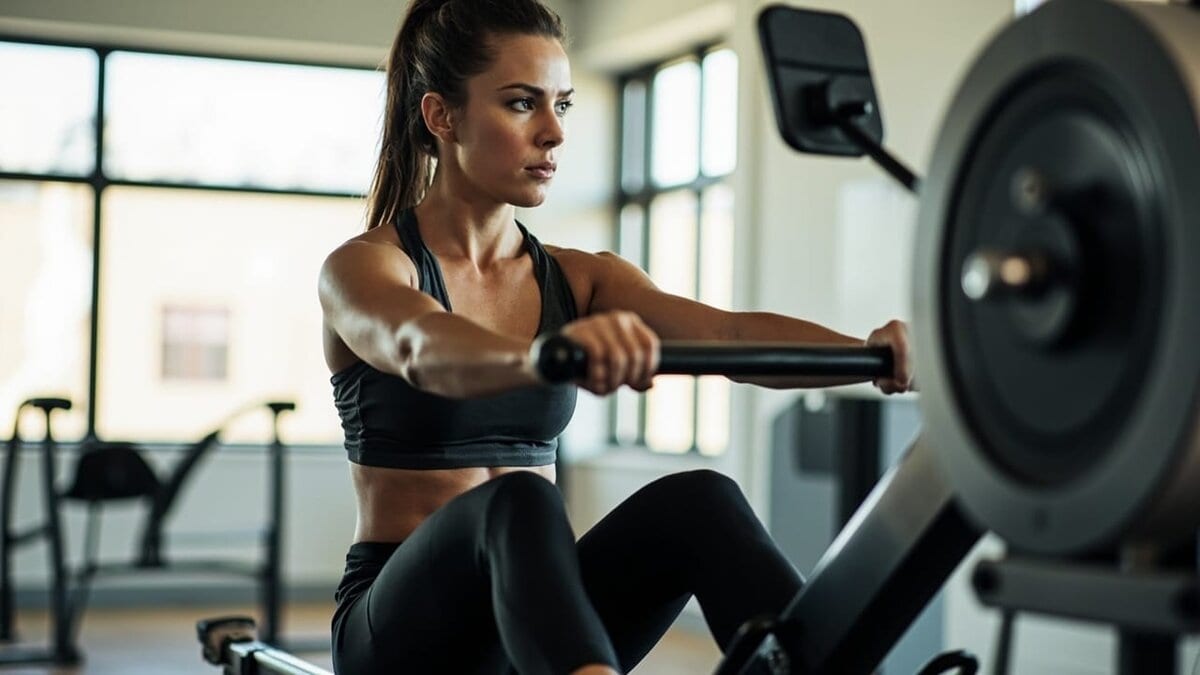
When you stack those facts together, the rowing machine workout ends up being an unusually efficient use of training time. You don’t need a separate cardio day and a separate strength day if you have limited hours to train. You don’t need to sacrifice your joints to get a serious calorie burn. And you don’t need a coach to figure out how to scale the workout, because the ergometer has built-in metrics that make progress measurable week to week.
The Rowing Machine Workout in Plain English
The rowing stroke has four phases. Skipping any one of them is the most common beginner mistake, and the reason people walk away from the rower saying it felt weird. Each phase has a job.
The catch. This is the starting position. Knees bent, shins roughly vertical, body leaning slightly forward from the hips, arms reaching straight out toward the flywheel. The chain should be at its longest extension. Most beginners cheat by starting with their knees bent and arms already bent, which collapses the power phase before it begins.
The drive. Push with the legs first. The legs do about 60 percent of the work in a properly executed stroke. As the legs extend, the body opens from the hips so the torso leans slightly back. Only after the legs are mostly straight do the arms pull the handle into the lower ribs. The order is legs, then back, then arms.
The finish. Legs straight, body leaning slightly back, handle pulled lightly into the stomach just below the ribs. Don’t yank the handle to the chest. that pulls the shoulders into a shrug. The elbows should pass close to the body, and the handle should travel in a straight line, not an arc up over the knees.
The recovery. This is the reverse. Arms extend forward first, then the body rocks forward from the hips, then the knees bend and slide the seat back toward the catch. The recovery should take about twice as long as the drive. Beginners almost always rush the recovery, which is one of the biggest energy leaks in any rowing machine workout.
The cadence is usually expressed as stroke rate, in strokes per minute (spm). A relaxed warm-up sits around 18. 22 spm. A moderate piece sits around 22. 26 spm. A sprint or a fast interval starts at 28+ spm and goes up from there. Slower doesn’t always mean easier. it often means the stroke is longer and more powerful, which is what you want during steady-state work.
Setting Up the Ergometer Before You Start
Most poor rowing machine workout experiences trace back to a bad setup. The three adjustments that matter most are the foot strap height, and the monitor orientation. Get these right and the stroke feels natural; get them wrong and even a strong athlete will produce ugly strokes and a sore lower back.
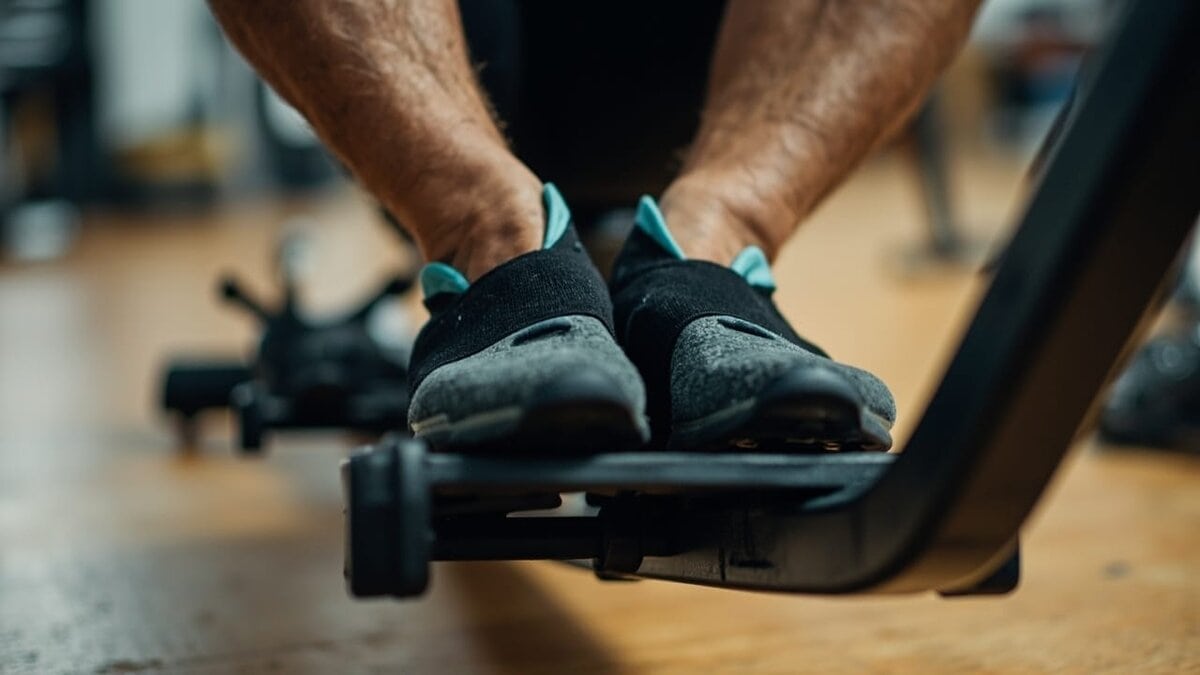
Foot straps. The strap crosses the widest part of your foot, near the ball of the foot and the base of the toes. Tighten the strap so your heel stays in contact with the footplate when your legs extend. If your heel lifts at the catch, the strap is too loose and the leg drive becomes a fight against the footplate itself.
Damper setting. The flywheel lever (usually 1. 10 on Concept2 rowers) controls how much air drag each stroke meets. Lower settings (3. 5) feel flywheel-heavy and force you to accelerate quickly through the leg drive. Higher settings (7. 10) feel sluggish and tire the legs before you finish a long piece. For most steady-state and interval workouts the right zone is 4. 6. The setting is not like a treadmill incline. rowing speed is independent of damper setting because each stroke is self-powered. The damper sets the feel of the stroke, not the difficulty of the workout.
Monitor. If the monitor faces flat across the room, you’ll crane your neck to read the splits. Set it on a slight angle so you can glance at the metrics without breaking body position. Most modern ergometers let you tilt the monitor arm a few degrees, which is all you need.
Once those three are set, take five slow strokes at a stroke rate of about 18 spm to confirm the catch position feels comfortable. If your lower back rounds at the catch, your hamstrings are tight and you need a slight knee bend before leaning forward. keep the back flat and reach from the hips, not the spine. This is exactly where rowing machine workout pays off in everyday life.
Calorie Burn Compared to Other Cardio Machines
Calories burned on any cardio machine depend on body weight, and duration more than they do on which machine you pick. That said, the rowing machine workout tends to land in the upper end of the calorie-burn range at matched perceived effort. A 155-pound adult rowing at a moderate steady state can burn between roughly 500 and 650 calories per hour. Push the intensity into a vigorous zone and the same person can hit 800+ calories per hour.
Direct comparison studies back this up. Moyna and colleagues at Dublin City University had subjects exercise on six common machines. treadmill, stair-stepper, cycle ergometer, rowing ergometer, and rider. at matched ratings of perceived exertion (RPE). At each RPE level the rowing ergometer was tied with the treadmill for highest energy expenditure in women and was within 10 percent of the treadmill in men, while outperforming the cycle ergometer and the stair-stepper. That means at any given level of perceived effort, the rower is delivering more or less the same cardio demand as running, with much lower joint loading.
What makes rowing unusually efficient at the calorie level is the combination of leg drive and upper-body pull. The more muscle mass you engage in a movement, the more energy the movement costs. A cycling session is essentially a lower-body-only movement. A jogging session adds some core stabilization but little arm contribution. Rowing delivers a full-body demand in every stroke, which is why a 20-minute rowing machine workout can leave you more winded than a 30-minute jog at the same heart rate.
For weight loss, the calorie number is a useful but imperfect signal. What matters more is the trend in resting metabolic rate, muscle mass preservation during a calorie deficit, and how consistently you can train week after week without breaking down. Rowing scores well on all three, which is why it has become a default in many home gym setups.
For a frame of reference on the cardio expenditure numbers above, the Harvard T.H. Chan School of Public Health tracks physical activity energy costs across modalities and uses the same MET-based conversions that drive the calorie numbers on most fitness monitors.
Steady-State Rowing Machine Workouts
Steady-state pieces are the bread-and-butter rowing machine workout. The goal is to row at a moderate, lasting intensity for a longer duration. These sessions build the aerobic base that makes the harder interval sessions possible later in the week.
Steady Plan A. 30 minutes at conversational pace. Row for 30 minutes at an intensity you can maintain while speaking in short sentences. Stroke rate around 22 spm. Damper setting 4. 5. The split (time per 500 meters) on the monitor should be steady across all 30 minutes. if it drifts up by more than 10 seconds per 500 m, slow down for the last 10 minutes. This is the standard steady-state rowing machine workout for beginners and the safest place to start.
Steady Plan B. 45 minutes at zone 2. Same idea but pushed out to 45 minutes. The longer duration forces a lower stroke rate and a smoother stroke, which builds efficiency. Most weeks this is the single longest session in the plan. Zone 2 means an effort level where you can hold a full conversation without gasping between sentences. Heart rate should sit around 60 to 70 percent of maximum for most adults.
Steady Plan C. 60-minute endurance row. Reserved for the week before a goal event or after you’ve built up to consistent 45-minute sessions for a month. The pace stays in zone 2 throughout. If you can’t hold zone 2 for the full hour, cut it short. better to row 50 minutes well than 65 minutes badly. There’s no prize for struggling through the last 15 minutes of a long row. This is exactly where rowing machine workout pays off in everyday life.
The single biggest mistake on long steady-state pieces is letting the stroke rate creep up while the pace stays the same. Higher stroke rate at the same pace means each stroke is shorter and weaker, which is exactly the wrong trade. If your stroke rate climbs, slow down the pace until the rate drops back to 22. 24 spm.
Interval rowing machine workouts
Interval work turns a rowing machine workout from a calorie-burning warmup into a real conditioning tool. Intervals alternate hard efforts with recovery periods so that each hard effort starts from a slightly rested state, which lets you hit a higher peak intensity than you could sustain continuously.
Interval Plan A. 6 × 500 m. Row 500 meters hard, then row 500 meters easy. Repeat six times. The hard 500s should be at a stroke rate of 28. 30 spm with strong leg drive. The recovery 500s should be at 18. 20 spm at a conversational pace. The whole piece takes about 22 minutes. This is the classic rowing machine workout for time efficiency and a great entry point to interval work.
Interval Plan B. 4 × 1000 m. Same structure but doubled distance. Each hard 1000 should be about 8 to 12 seconds slower per 500 m than your 6 × 500 pace. The recovery 1000 is at a slow conversational pace. Total time around 28 minutes. This session is more aerobic than the 6 × 500, which makes it a better choice for building the base that lets the shorter intervals hit harder.
Interval Plan C. 8 × 250 m sprint. Eight rounds of 250 m hard with 90 seconds of easy rowing between. Stroke rate climbs into the low 30s. This is a lactate tolerance session, which builds the ability to keep producing power under accumulating fatigue. Beginners should build up to this gradually. start with 4 rounds and add one every two weeks.
Interval Plan D. Tabata-style 20×30 seconds. Twenty rounds of 30 seconds hard with 30 seconds easy between. Total piece is exactly 20 minutes including the warmup and cooldown. The 30-second hard efforts should be at the highest power you can hold for 30 seconds, which usually means stroke rate 32+ with aggressive leg drive. This is a popular rowing machine workout for HIIT days because it stacks a real cardio demand on top of strength endurance and finishes in 20 minutes flat.
Across all interval sessions, the recovery between intervals is not optional. Skipping the recovery turns the interval session into a continuous hard effort, which negates the entire point of the intervals. Take the recovery.
Beginner rowing machine workouts
If you’re new to the rower, the right starting point matters more than the right end point. The classic beginner mistake is to climb on, pull as hard as possible for 5 minutes, and never come back because everything hurt. The fix is to start with technique-first sessions and build duration before intensity.
Beginner Plan A. 4 × 4 minutes technique focus. Four rounds of 4 minutes rowing at a relaxed conversational pace. The point is not the workout. it’s the stroke. Spend the full 4 minutes on each round focusing on one phase of the stroke: round 1 on the catch and the leg drive, round 2 on the sequencing of legs-back-arms, round 3 on the finish position, round 4 on the controlled recovery. Between rounds, stand off the rower for 1 minute and shake out the legs. Real-world examples of rowing machine workout in action are everywhere once you start looking.
Beginner Plan B. 10 minutes steady. Once the stroke pattern feels natural, row for 10 minutes continuously at a conversational pace. Stroke rate 20. 22. Ten minutes is short enough that anyone can manage it, even on day one, but long enough to find a rhythm and start feeling the full-body demand. Add 2 to 5 minutes per week until you’re at the 30-minute steady-state piece.
Beginner Plan C. Pyramid intervals. 1 minute hard, 1 minute easy, 2 minutes hard, 2 minutes easy, 3 minutes hard, 3 minutes easy, 2 minutes hard, 2 minutes easy, 1 minute hard, 1 minute easy. This pyramid builds and unwinds so the total work-to-rest ratio feels balanced. Stroke rate climbs with each harder effort. This is a beginner-friendly rowing machine workout that introduces interval structure without the bar of holding a fixed split for 30 minutes.
Beginners often worry about whether the rowing machine workout is safe for their back. The honest answer is that it’s safe when the stroke is correct and unsafe when it’s not. The most common back-pain trigger is rounding the lower back at the catch, which happens when the hamstrings are tight or the seat slides too far forward. Keep the back flat and reach from the hips, and a rowing machine workout is one of the lowest-back-stress cardio options you can pick.
Rowing machine workout mistakes
After a few hundred sessions watching people climb on and off the rower, the same handful of mistakes keep showing up. None of them are subtle, and all of them are fixable.
Mistake 1. Pulling with the arms first. The arms finish the stroke. They do not start it. If the arms bend before the legs drive, the back collapses forward and the legs only get a fraction of their useful contribution. The fix is to think “push with the legs, swing the back, then pull” and ignore the arms for the first quarter of every stroke.
Mistake 2. Rushing the recovery. Most beginners recover twice as fast as they drive. The drive should be powerful and accelerate the handle. The recovery should be slow and controlled so the body has time to reset. A 1:2 drive-to-recovery ratio is the target. If your stroke rate is climbing but your split is the same, you are recovering too fast. This is exactly where rowing machine workout pays off in everyday life.
Mistake 3. Setting the damper too high. Concept2 rowers default to damper setting 10 out of the box. Setting 10 is fine for a 2k test on a trained athlete but punishing for everyone else. Most steady-state and interval work sits at settings 4. 6. The flywheel setting is a feel preference, not a difficulty knob.
Mistake 4. Skipping the warmup. Five minutes of easy rowing with a stroke rate below 20 spm is enough to warm the muscles and prime the cardio system before the first hard piece. Without a warmup, the first 500 meters of any rowing machine workout will feel awful and the form will collapse.
Mistake 5. Holding the handle in a death grip. The handle should sit in the fingers, not the palm. The grip should be light enough that you could drop the handle at any moment. A tight grip pulls the shoulders up toward the ears, which over a long session becomes neck and trap soreness that people blame on “rowing being bad for your back” when it’s grip and shoulder tension.
Mistake 6. Rowing every session at the same intensity. Steady-state every day produces slow adaptation. The body needs a stress signal to adapt, and constant zone 2 work is not enough stress for most beginners. Mixing one or two interval sessions into the weekly plan produces faster fitness gains than the same total time at one steady pace.
All six of these mistakes are easy to fix by changing one or two specific habits. None of them require new equipment or a coach on hand. The next session you row, pick the one that sounds most like yours and commit to fixing it for two weeks.
How often should you row
For most healthy adults, three to five rowing machine workouts a week is the productive range. Three sessions per week is enough to drive meaningful fitness improvements for beginners. Five sessions per week is the upper limit for trained athletes who are also managing strength training outside the rowing sessions.
A reasonable weekly template looks like this: one longer steady-state piece (30. 45 minutes), one interval session (15. 25 minutes plus warmup), one technique-focused session (20. 30 minutes at low intensity), one shorter steady-state piece (15. 20 minutes), and one recovery row (10. 15 minutes, easy). The two interval sessions and the longer steady-state piece carry most of the fitness signal. The technique session and the recovery row are the glue that holds the plan together without piling on extra fatigue.
Recovery matters more than frequency. A rowing machine workout pulls on the lower back, the hamstrings, and the lats in roughly that order. Three quality sessions a week with full recovery between beats five mediocre sessions in a row. If you can train four days a week, structure it as two on, one off, two on, two off. If you can train five, alternate hard and easy days.
Cross-training goes a long way here. A strength-focused day that hits the squat, hinge, and pull patterns complements a rowing machine workout well. The rower covers the cardio and the pulling, and the strength session covers the upper-body pressing and the heavy lower-body loading that the rower doesn’t deliver. Most week-to-week plateaus in indoor rowing training come from doing only rowing and missing the strength work that supports it.
Pairing rowing with strength training
Pairing a rowing machine workout with a short strength session on the same day produces faster fitness gains than either one alone. The combination works because rowing hits the cardiovascular system and the posterior chain, while a strength session hits the pressing muscles, and the grip under long tension.
A practical weekly split looks like this: Monday row for 30 minutes plus a 20-minute full-body strength session; Tuesday interval row plus light mobility; Wednesday rest; Thursday 45-minute steady row plus a 25-minute lower-body strength session; Friday short steady row plus upper-body strength; Saturday long endurance row; Sunday full rest. Real-world examples of rowing machine workout in action are everywhere once you start looking.
When pairing, do the rower first on hard days. A rowing machine workout raises the heart rate and warms the major muscle groups, which is exactly what you want before a strength session. Doing strength first is fine for technique days but tends to leave the rower session flatter than it needs to be.
The two modalities also complement each other through fatigue management. A rowing machine workout pre-fatigues the lower back, which limits heavy deadlift volume. By alternating days, you avoid stacking two lower-back-intensive sessions in a row, which over a long training block is one of the most common paths to overuse injury.
Tracking progress without obsessing
The best thing about the rowing machine workout as a modality is that the monitor gives you a clean, objective record of progress. Three numbers tell you almost everything you need to know.
The first is your 2000-meter row time. Row 2000 meters as hard as you can sustain, the same way every time, every four to six weeks. The split (time per 500 m) is the headline number. every four-second drop in your 2000 m split represents a meaningful jump in your aerobic fitness. Most beginners will see their 2000 m split drop between 10 and 30 seconds over the first three months of consistent training.
The second is your average heart rate for the same 2000 m row. As your fitness improves, your heart rate at the same split drops. If you row a 2:00/500 m split at 165 bpm this month and the same 2:00/500 m split at 158 bpm next month, your aerobic system is doing more work per heartbeat. That’s the definition of aerobic fitness boost.
The third is your stroke efficiency, which you can estimate by tracking how far you travel per stroke. Most monitors show this as part of the per-stroke data. As your technique improves, you travel further per stroke at the same effort, which means you’re applying more power per stroke and wasting less energy in the recovery.
Don’t chase all three numbers every session. Pick one. usually the 2000 m row time. and use it as the main marker of long term progress. The other two are diagnostic. If your stroke efficiency is dropping while your split is improving, the form is breaking down under fatigue and you need a technique session, not another hard interval.
Frequently Asked Questions
How long should a rowing machine workout be for fat loss?
For fat loss, 20 to 45 minutes per session, three to five times a week, is a productive target. The exact duration matters less than the consistency over weeks. A 25-minute rowing machine workout most days of the week will produce better results than a heroic 60-minute session you only manage once.
Is the rowing machine workout good for weight loss in the legs specifically?
Spot reduction is not real, but a rowing machine workout does train the quadriceps, and the hamstrings as the primary movers. Combined with a calorie deficit and a strength-training plan that targets the lower body under load, leg definition improves over a few months.
Can a rowing machine workout build muscle?
The rowing machine workout builds muscular endurance across the major muscle groups, especially the legs, the back, and the biceps. It does not build large amounts of hypertrophy in any one muscle. For visible muscle growth, pair the rowing with a strength-training plan that uses progressive overload on the squat, hinge, and pull patterns.
Is a rowing machine workout bad for your back?
A rowing machine workout is one of the lower-back-friendlier cardio options when the stroke is correct. The most common lower-back issue comes from rounding the spine at the catch, which happens when the hamstrings are tight or the seat slides too far forward. Keep the back flat and reach from the hips, and the rower is gentler on the lower back than running or jumping rope.
How many calories does a 20-minute rowing machine workout burn?
A 20-minute rowing machine workout at moderate intensity burns roughly 170 to 220 calories for a 155-pound adult, and 220 to 280 calories at vigorous intensity. Higher body weights burn proportionally more. The variance is large because intensity, and stroke rate all change the demand, but a 20-minute row always lands in the same general ballpark as a 20-minute run.
Should I do a rowing machine workout every day?
Most adults do best with three to five rowing machine workouts per week, not seven. Daily rowing works for a few weeks at low intensity but the lower-back and hip-flexor demand adds up. Pair rowing days with strength days, and full rest days for the most lasting plan.
Is the rowing machine workout better than running?
The rowing machine workout and running are different tools with different strengths. Running trains the lower body and the cardio system at higher peak intensities. Rowing trains the full body at slightly lower peak intensities, with much lower joint impact. For people who can’t run, or who want a single modality that hits both cardio and strength, the rowing machine workout is the better fit.
What should I eat before a rowing machine workout?
A light meal 60 to 90 minutes before a rowing machine workout, centered on easy carbs and a moderate amount of protein, is enough for most people. A banana, a slice of toast with peanut butter, or a small bowl of oatmeal all work. Heavy meals before rowing tend to sit in the stomach and feel uncomfortable, especially during interval work.
The bottom line
A rowing machine workout is one of the most efficient single-modality cardio choices you can make. The body of research, from energy expenditure comparisons at matched effort to longitudinal training studies in clinical populations, supports the use of indoor rowing as a primary aerobic modality. The American Heart Association’s 150-minute weekly target and muscle-strengthening recommendations are both satisfied inside a vigorous rowing session. The low joint impact makes the modality accessible to older adults, and anyone carrying extra body weight.
The full plan above. three to five sessions per week, mixing one longer steady-state piece, one interval session, and one short steady piece. is enough to drive real fitness gains for most beginners and a productive training block for trained athletes. Twelve ready-to-row sessions are listed in the sections above; rotate through them in the order suggested, swap steady-state for intervals every other week, and track your 2000 m split every four to six weeks. The monitor will tell you whether the plan is working. This principle is central to rowing machine workout and worth repeating.
If you only have 20 minutes on a busy day, the tabata-style 20×30 seconds interval is the most efficient rowing machine workout in the rotation. If you have an hour, the 45-minute steady-state piece is the one that pays off over months. The rower doesn’t care which one you pick, as long as you keep showing up.
Related Reading on Weight Loss Full
- fitness training that work. building a complete weekly workout schedule around rowing intervals
- best physical fitness for weight loss. common mistakes when pairing cardio with calorie deficit goals
- nutritious meals that work. nutrition timing to support a busy training week
- weight reduction benefits for weight loss. what the research says about rowing and metabolic health
- balanced nutrition mistakes to avoid. fueling long steady-state rows and high-intensity intervals
Medical Disclaimer: This article is for informational purposes only and does not constitute medical advice. Consult a qualified healthcare provider before starting any weight loss program.


