




Medical Disclaimer: This content is for informational purposes only. Consult a qualified healthcare professional.
Calorie Deficit Calculator: How to Estimate Your Daily Deficit for Weight Loss
A calorie deficit calculator turns your age, sex, height, weight, and activity level into an estimate of your daily calorie needs. Most weight loss advice starts with a number you cannot check, and a calorie deficit calculator at least tells you where to start.
Below is how the math works inside a calorie deficit calculator, where popular shortcuts go wrong, and how to turn a target into meals you will actually eat. Figures come from the National Institute of Diabetes and Digestive and Kidney Diseases (NIDDK) and peer reviewed research on energy balance and protein.
Anyone with a medical condition, or who is pregnant, should talk with a clinician before making big changes to calories or activity. Estimates are starting points, and your own data is what turns them into a workable plan.
Using the calorie deficit calculator to set a realistic daily target.
Table of Contents
- What a calorie deficit actually is
- Why the 3,500-calorie rule misleads
- How the calorie deficit calculator estimates daily needs
- 500 versus 1,000 calories a day
- Turning the deficit into meals
- How exercise changes the deficit
- Tracking progress and adjusting
- Common mistakes
- When to stop and see a doctor
- Frequently asked questions
What a Calorie Deficit Actually Is
A calorie deficit is the gap between the calories you eat and the calories your body uses. When intake runs below expenditure for a while, the difference comes out of stored energy, mostly fat, and your weight moves down. Everything else is arithmetic on top of that gap.
A deficit is not the same as restriction. Skipping meals or banning a food group fails for a predictable reason: the plan is hard to hold, and hard-to-hold plans end early. A repeatable eating pattern matters more than short bursts of discipline.


Energy balance shifts as your weight changes, so the number a calorie deficit calculator hands you drifts.
Why the 3,500-Calorie Rule Misleads
The rule almost everyone quotes says a 3,500-calorie deficit produces one pound of fat loss. The problem is that it treats energy balance as fixed, and real bodies are not.
Researchers writing in the International Journal of Obesity argued that the serious error in the rule is its failure to account for dynamic changes in energy balance. Simple math then overestimates losses and predicts a straight line with no plateau.
The same letter notes that 3,500 calories per pound fits modest weight changes in people with overweight and obesity, but overestimates for others. The rule treats the body like a fixed furnace, and a calorie deficit calculator built on that rule will over-promise in the second month.
That dynamic point applies to your own plan. As you lose weight, the balance between what you eat and what you burn shifts, so a target set in week one drifts. A calorie deficit calculator that ignores that drift keeps handing you stale advice.
How a Calorie Deficit Calculator Estimates Daily Needs
Most calorie deficit calculators work in two steps. First they estimate resting energy expenditure, the calories your body burns to stay alive, usually called BMR. Then they multiply by an activity factor to get total daily energy expenditure, or TDEE.
Your target is TDEE minus the gap you choose to run. A calorie deficit calculator gives you the TDEE figure first, and the gap is the part you pick.
The most widely used equation is Mifflin-St Jeor, published in 1990 in the American Journal of Clinical Nutrition. It was derived from 498 healthy adults whose resting energy expenditure was measured by indirect calorimetry.
The equation explained 71 percent of the variation in measured resting energy expenditure, and the older Harris-Benedict equation overestimated measured resting expenditure by about 5 percent. Fat-free mass predicted resting expenditure better than body weight alone.
For men: (10 x weight in kg) + (6.25 x height in cm) minus (5 x age) + 5. For women: the same, minus 161.
For the activity step, the NIDDK Body Weight Planner is a calorie deficit calculator with a published model. It uses a physical activity level from 1.4 for a sedentary life to 2.5 for a very active one, with 1.6 as the default.
That default describes someone mostly sitting, plus moderate activity such as walking or cycling once a week. Values between those anchors are scenarios you test rather than official categories, and each one is an estimate of your own spending rather than a measurement.
The planner also notes that people often underestimate how much they eat, and that its numbers run high if your metabolism is unusually low or you are very sedentary. So calorie deficit calculator numbers are often better than a memory based guess. Use the estimate to set a starting target, then adjust it with real data.
| Activity level | What it describes |
|---|---|
| 1.4 | Sedentary |
| 1.6 | The planner’s default: mostly sitting, with walking or cycling once a week |
| 2.5 | Very active |
One worked example. A woman, 34, 165 cm, 70 kg, gets a resting estimate of (10 x 70) + (6.25 x 165) minus (5 x 34) minus 161, which is 1,400 calories.
At an activity level of 1.6 her daily need is about 2,240, and a calorie deficit calculator would return the same figure for her. A 500-calorie gap puts her near 1,740 calories a day. A man, 42, 180 cm, 90 kg gets a resting estimate of 1,820 and a total near 2,912, or 2,412 with the same deficit.

A calorie deficit calculator gives you a starting point for daily calorie needs, not a verdict.
500 Versus 1,000 Calories a Day
Two numbers dominate the conversation, and a calorie deficit calculator makes it easy to pick one. A 500-calorie daily gap is about 3,500 calories a week, and a 1,000-calorie gap is about 7,000 calories a week. Multiply either by the old 3,500-calorie rule and you get the familiar promises of one or two pounds a week.
For most people the smaller gap is the better choice. NIDDK’s game plan for preventing type 2 diabetes suggests a good short-term goal of 1 to 2 pounds per week, and the old arithmetic puts a 500-calorie gap at the slow end of that range.
The same materials list 5 to 10 percent of starting weight within six months as a realistic target, which for someone at 200 pounds means 10 to 20 pounds. A calorie deficit calculator helps you test that percentage against your own scale. Adherence, not arithmetic, decides most outcomes, and the smaller gap leaves room for the meals you like.
The larger gap suits specific situations: a higher starting need, a shorter timeline, or a clinician-reviewed plan. A calorie deficit calculator will not stop you from choosing it, it will just hand you the number faster.
It is harder to sustain, takes a bigger cut from protein and training, and leaves less room for error when a plan has to last months.
NIDDK’s own table sets 1,200 calories a day for people in the lightest weight range, and the same material notes that eating less than 1,200 calories a day is not advised. A 1,000-calorie gap can land below that line, so raise the target rather than push harder.
| Current weight | Calories per day | Fat grams per day |
|---|---|---|
| 120 to 170 pounds | 1,200 | 33 |
| 175 to 215 pounds | 1,500 | 42 |
| 220 to 245 pounds | 1,800 | 50 |
| 250 to 300 pounds | 2,000 | 55 |
Source: NIDDK’s game plan, which notes that eating less than 1,200 calories a day is not advised.

Comparing a 500 and 1,000 calorie deficit against NIDDK’s minimum intake guidance.
Turning the Deficit Into Meals
A calorie deficit calculator gives you a number, and a number is not a meal plan. The number tells you how much energy to work with, and food quality decides whether you can hit it without hunger all day. Three levers matter most: protein, fiber, and plate construction.
Protein does more than fill you up, and no calorie deficit calculator can tell you how much of it you need. A systematic review and meta-analysis of 49 studies with 1,863 participants found that protein supplementation during resistance training increased one-repetition maximum strength by about 2.5 kg. It also added roughly 0.3 kg of fat-free mass.
That tissue matters for weight loss because fat-free mass predicts resting expenditure better than body weight. The same review found no extra fat-free mass benefit once protein intake passed about 1.6 grams per kilogram of body weight per day.
At that rate a 70 kg person needs about 112 grams a day, which is a practical floor rather than a universal requirement. Fiber does the volume work: vegetables, fruit, beans, lentils, and whole grains add bulk for few calories.
NIDDK’s eating and physical activity guidance recommends vegetables of all types, whole fruit rather than fruit juice, whole grains, low-fat dairy, and protein from lean meats, poultry, eggs, seafood, beans, lentils, and nuts.
The same guidance advises limiting added sugars and saturated fat to under 10 percent of calories each, and salt to under 2,300 milligrams a day. Portions matter more than food rules, and NIDDK’s diabetes-prevention materials describe a plate method for building a meal.
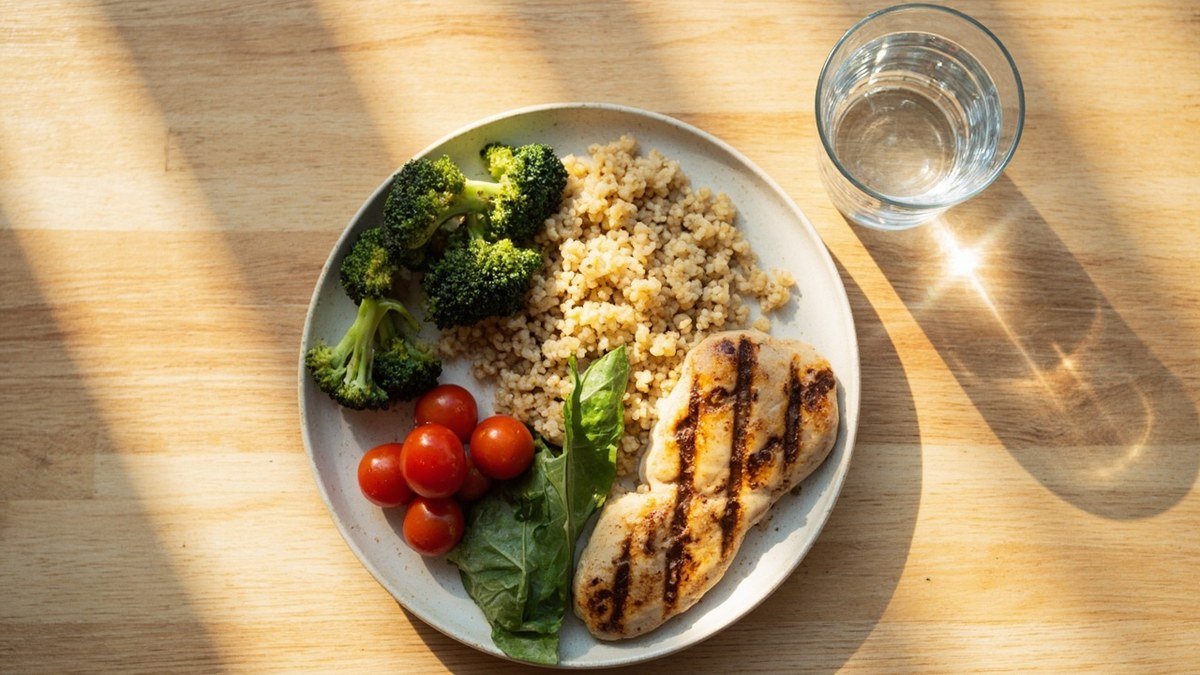
Half the plate goes to fruits and vegetables, one quarter to a lean protein such as chicken without the skin or beans, and one quarter to a whole grain. Hands work as a guide too: a serving of meat is about your palm, and a 3-ounce piece of fish about a checkbook.
See how to meal prep for the week and a high protein breakfast guide for the routine behind this.

Building a calorie deficit plan around protein, fiber, and food quality.
How Exercise Changes the Deficit
Exercise changes both sides of the equation, and a calorie deficit calculator will never know about the cardio you add. It raises what you burn, and it protects lean mass, which predicts resting expenditure better than body weight. Resistance training matters more for the long run than its calorie burn suggests.
The federal physical activity guidance for adults recommends at least 150 minutes a week of moderate-intensity aerobic activity such as brisk walking. The Physical Activity Guidelines for Americans also put muscle-strengthening work on two or more days a week covering all major muscle groups.
NIDDK’s own guidance sets the regain target higher, at 300 minutes a week of moderate-intensity activity, and notes that regular physical activity may help keep lost weight from coming back. Treating a workout as permission to eat back everything you burned is a well-worn mistake.
Raise your activity factor in the calculation instead, then run the calorie deficit calculator again. Judge progress from the scale and tape over several weeks rather than one session.
A weekly pattern of two or three resistance sessions plus daily walking already clears both targets. Weight loss tips that hold up in practice covers habits that survive a busy week.
Tracking Progress and Adjusting When It Stalls
Tracking turns a guess into a measurement, and it is the one job a calorie deficit calculator cannot do for you. Four numbers are worth recording: weight, food intake, activity, and energy. Weigh yourself on the same day each week and look at the average over two to three weeks.
Day to day swings come from water, salt, and digestion. A weight loss journal template makes this faster than a blank page, and NIDDK’s guidance points to a phone app or printed log for food, movement, and weight.
The two to three week rule is a practical heuristic, not a rule from a study. It is how you test a calorie deficit calculator estimate against what the scale actually does. If your weekly average has not moved for two to three weeks while your food tracking has been honest, something in the estimate is wrong.
Work through the usual suspects in order: portion sizes, drinks, weekend meals, and an activity factor that no longer matches your life. Your weight is down, so your expenditure is too, which means last month’s target is now too generous. Re-run the calorie deficit calculator and the number changes.
Cut 100 to 200 calories, or add one or two longer walks a week, then give it another two to three weeks. Bigger cuts at that point usually produce a short dip, a rebound, and a worse relationship with food.
Ten reasons people stall despite eating well and diet mistakes that quietly stall weight loss cover the usual causes.
Common Mistakes
Most stalled attempts share a short list of causes, and the first item is the one a calorie deficit calculator cannot see. Estimating calories by eye comes first, because restaurant portions, mixed dishes, and cooking oil rarely match the mental estimate. NIDDK’s prevention materials tell you to use the Nutrition Facts label for calories and fat grams.
They also advise drinking water instead of sugary drinks such as soda, sports drinks, and fruit juice. A deficit that is too aggressive is second on the list: cut too hard and hunger, poor sleep, and low training output take over.
Dropping protein and resistance training while dieting is third, losing the tissue you want to keep. Treating exercise calories as banked is fourth. Waiting for a plateau to fix itself is fifth, when the estimate needs updating instead.
Weekends cause their own damage, mostly through all-or-nothing thinking. NIDDK treats setbacks as normal, and suggests reviewing your plan and getting back on track as soon as possible.
One large meal is a single day inside a 500-calorie gap. Counting it as failure is what turns one meal into a bad week.
When to Stop and See a Doctor
Some situations are not for a calorie deficit calculator. NIDDK’s Body Weight Planner carries a clear disclaimer: the information is for adults 18 and older, not for younger people or for pregnant or breastfeeding women, and it is not medical advice.
If you are pregnant or breastfeeding, or you have heart disease, high blood pressure, or diabetes, talk with a clinician before you start. NIDDK’s guidance for people with those conditions is to speak with a health care professional before starting regular physical activity.
Seek advice if your weight is dropping much faster than planned, if your target falls below the 1,200 calorie floor, or if the plan leaves you too tired or hungry to sustain. Losing weight faster than planned is a reason to call a clinician, not a reason to cut harder.
Set the goal with a professional rather than around one. NIDDK’s guidance on choosing a safe program says a health care professional may work with you to build a plan that fits your needs. A good program includes realistic goals, ongoing support, and a plan for keeping weight off.
Frequently Asked Questions
How many calories should I cut per day to lose weight?
For most adults, roughly 500 calories a day is the most defensible starting point, and a calorie deficit calculator is how you find the number you subtract from. NIDDK suggests 1 to 2 pounds per week as a good short-term goal, and the old arithmetic puts a 500-calorie gap at the slow end of that range.
Larger cuts go faster for a while but are harder to sustain and risk losing muscle. If a plan drops you under 1,200 calories, raise the target or get medical advice first.
How do I calculate my daily calorie needs?
A calorie deficit calculator does it in seconds, and you can do it by hand too. Use Mifflin-St Jeor for resting energy expenditure, then multiply by an activity factor.
Men: (10 x weight in kg) + (6.25 x height in cm) minus (5 x age) + 5. Women: the same, minus 161.
Then apply 1.4 for a sedentary life, 1.6 for the planner’s default, or up to 2.5 for very active days. Subtract your chosen deficit from that total.
Is a 1,000-calorie-a-day deficit safe for me?
For many people it is not, and a calorie deficit calculator will hand you the same number without asking about your health. It suits higher starting needs and shorter timelines, and it is better reviewed with a clinician first.
It is more aggressive than the suggested pace of 1 to 2 pounds per week, and it leaves less room for error over months.
People with medical conditions, and anyone pregnant or breastfeeding, should not attempt a large deficit without professional guidance.
Why am I not losing weight even though I think I am in a calorie deficit?
Most often it is measurement, not metabolism, and a calorie deficit calculator cannot see a tablespoon of oil in the pan. People underestimate intake, and label numbers cover one serving. Water retention from salt or new training can hide fat loss for weeks, and your target may also be stale since expenditure falls as weight falls.
Track your weekly average for two to three weeks, audit portions and drinks, then adjust the estimate rather than the effort.
How long should it take to lose 10 pounds?
At a sustainable pace of 1 to 2 pounds per week, expect roughly five to ten weeks, and expect that to drift as you get lighter. A calorie deficit calculator gives you a pace, not a date.
NIDDK frames a realistic target as 5 to 10 percent of starting weight within six months, so 10 pounds is often a first milestone rather than a finish line.
Is a deficit calculator accurate enough to trust?
Trust a calorie deficit calculator as a starting point, not a measurement. The underlying equation explained about 71 percent of the variation in measured resting energy expenditure, and fat-free mass predicts it better than body weight.
The useful part is that it gives you a target you can adjust after two to three weeks. The risk is treating the output as fact rather than hypothesis.
Should I eat less or exercise more to lose weight?
Both, with the deficit doing the weight work and activity doing the supporting work, and a calorie deficit calculator only covers the first half. NIDDK’s prevention guidance puts lower-calorie food and drink choices first and being more active second.
A moderate deficit you can hold, plus 150 minutes of moderate activity and two strength sessions a week, is a reasonable pairing. Activity also helps keep weight off, where many people lose ground.
Put the plan in place.
Calculate once with a calorie deficit calculator, then let real data take over. Use Mifflin-St Jeor with an honest activity factor, and set a target around 500 calories below the result. Build meals around 1.6 grams of protein per kilogram of body weight, half a plate of vegetables and fruit, and water instead of sweet drinks.
Track your weight weekly and your food for two to three weeks. If the average moves, keep going and recalculate as your weight changes. If it does not, audit portions and drinks, then trim 100 to 200 calories or add two walks a week.
Anyone with a medical condition, or who is pregnant or breastfeeding, should make these changes with a clinician, not a spreadsheet.